



An exhibition of jewellery, small objects and films that investigates Anangu jewellery and other three-dimensional design tradition and experimentation. It features works created in the new mediums of resin and silver, from workshops undertaken on country with Kate Rohde, curated by Emily McCulloch Childs.
We are so excited to finally launch our amazing jewellery!
New direction for Anangu artists
In an Australia-wide first, artists from two leading art centres of the APY Lands and Western Desert have adapted their long practiced tradition of jewellery-making into a new medium of resin. The results are being launched this Thursday at Adelaide's JamFactory as part of the Tarnanthi Festival. Artists are flying down for the event.
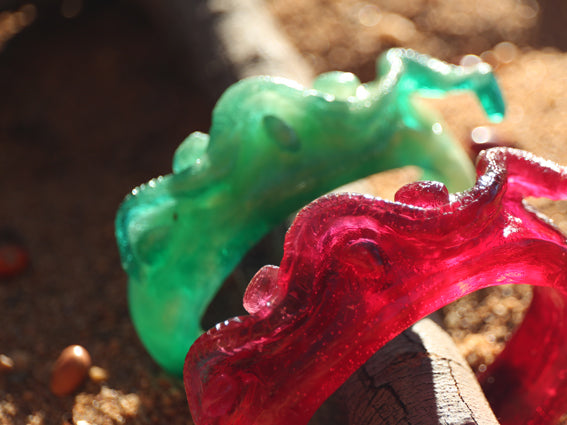
'Jewellery has always been here', an exhibition by artists of Ernabella Arts at Pukatja (Ernabella) in South Australia and Ikuntji Artists at Haasts Bluff in the Western Desert, comprises brilliantly coloured resin jewellery and small sculptural objects as well as a selection of works in silver.
The idea of introducing Aboriginal artists to resin came to Victorian-based curator and author Emily McCulloch Childs, co-director of art company McCulloch & McCulloch, after seeing resin used in contemporary jewellery. She approached the two art centres about the project, which received significant support from the Australia Council for the Arts and the South Australian Government through Arts SA.
McCulloch Childs, who has spent 20 years working with Aboriginal art and artists, says she immediately 'sensed the potential'. 'I imagined the brilliant earthy ochres, reds and yellows of the desert, and thought about how they would look suspended in clear resin,' she says. 'I thought the artists would have huge fun with colour.'
Her instinct proved correct. After a series of workshops on country, the results are a vibrant array of pendants and earrings, rings and bangles. They are all one-of-a-kind, which is important as the artists' designs are sacred, Emily McCulloch Childs explains.
The workshops at Ikuntji were led by Melbourne jewellery designer Kate Rohde, and to the intense delight of the artists, her bags were full of resin products and equipment. Rohde says the artists were 'immediately and fearlessly innovative' in a process that took the natural step of placing familiar seeds, grasses, twigs, feathers and sand into resin.
Rohde adds: 'Seed beading has been practised at Ikuntji for many years. So placing seeds in resin to create jewellery was a natural extension of their existing practice.'
The Ikuntji artists have named their designs after the plants used in their work: Puntu, Pura, Mulga, Ngaru – native plants important to the Luritja/Pintupi people of Haasts Bluff.
These new works are a new expression of the tradition McCulloch Childs refers to when she says, 'Jewellery has always been here'. Traditional Anangu jewellery employed seeds, grasses, feathers and hair – materials intimately connected with country. The new resin jewellery uses the same materials but in an entirely new way.
The project brought together the two art centres in an unusual way. Over the year-long project, artists from Ernabella Arts and Ikuntji Artists shared their techniques and knowledge as they developed their jewellery practice through various workshops. The project has also led to silversmithing workshops. Both projects were supported by the Australia Council for the Arts.
There is also a short film documenting the workshops and the journey of this project which is on display at the exhibition.